TPC Locum Survey Report 2025 - The state of locum pharmacy in the UK: rates, workforce pressure, and the human cost.
30 Jul . 21 min read.
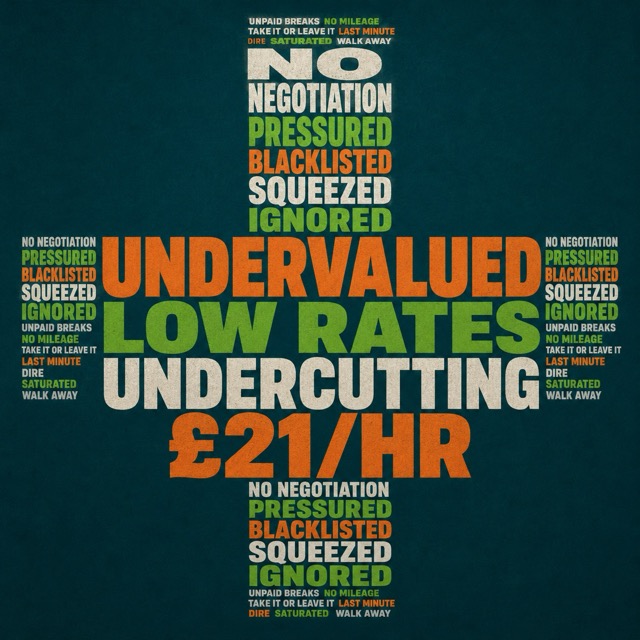
This is the third year we have run the TPC Locum Survey, and this year 154 UK pharmacists took part. Each one gave us their name, email address, and GPhC registration number, so we know these are registered pharmacists rather than anonymous form-fillers. We asked about their experience of the locum market over the previous 12 months, with fieldwork running from February to May 2026. Our 2023 survey had 300 respondents and our 2024 survey 218, so we can track most of the headline numbers across all three years.
There is some good news this year. Fewer locums struggled to find bookings than in 2024, and fewer reported being intimidated for asking for more money. But the relief is narrow. Rates have now fallen for three years running, and the longer you sit with the free-text answers, the clearer it becomes that the cost of that fall is being paid by individual pharmacists, both locum and employed.
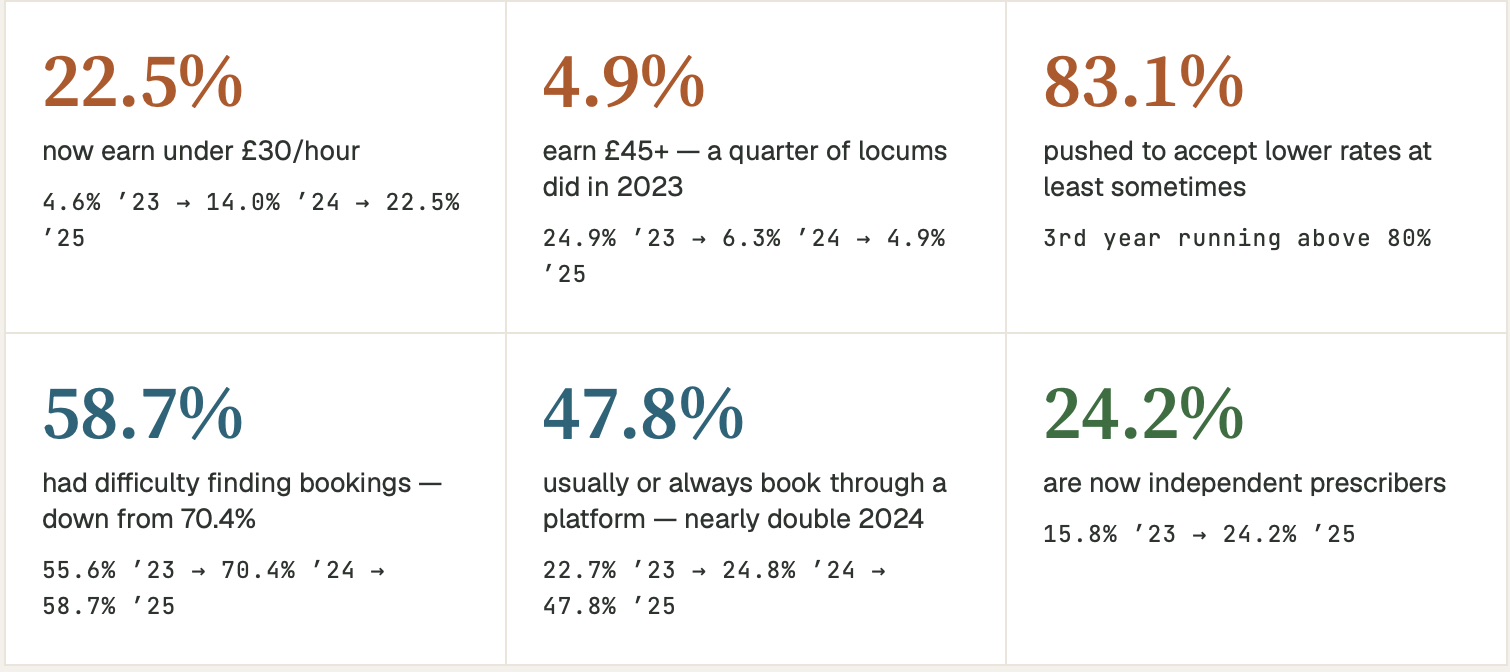
- Rates fell again. 22.5% of locums now earn under £30 an hour. That was 14.0% last year and just 4.6% in 2023. At the other end, the share earning £45 or more has dropped from 24.9% in 2023 to 4.9%.
- An outside source says the same thing. Syrkle Reviews, the community rate-transparency platform UK pharmacists use to log what they were paid, puts the median rate at £37 across its whole dataset but only £31 for bookings made since April 2025. One reviewer in ten was paid £25 an hour or less.
- Pressure on rates is still almost universal. 83.1% of those answering had been pushed to accept lower rates at least sometimes (55.8% said yes, 27.3% said sometimes).
- Finding work got easier; staying busy did not. 58.7% reported difficulty finding bookings, well down from 70.4% in 2024. But 73.2% still had days each month when they were free to work and could not get booked, and 21.8% lost more than ten days a month that way.
- Intimidation is down, not gone. 17.5% had been threatened or intimidated for asking for a higher rate, down from 25.3% in 2024. That is still about one locum in six.
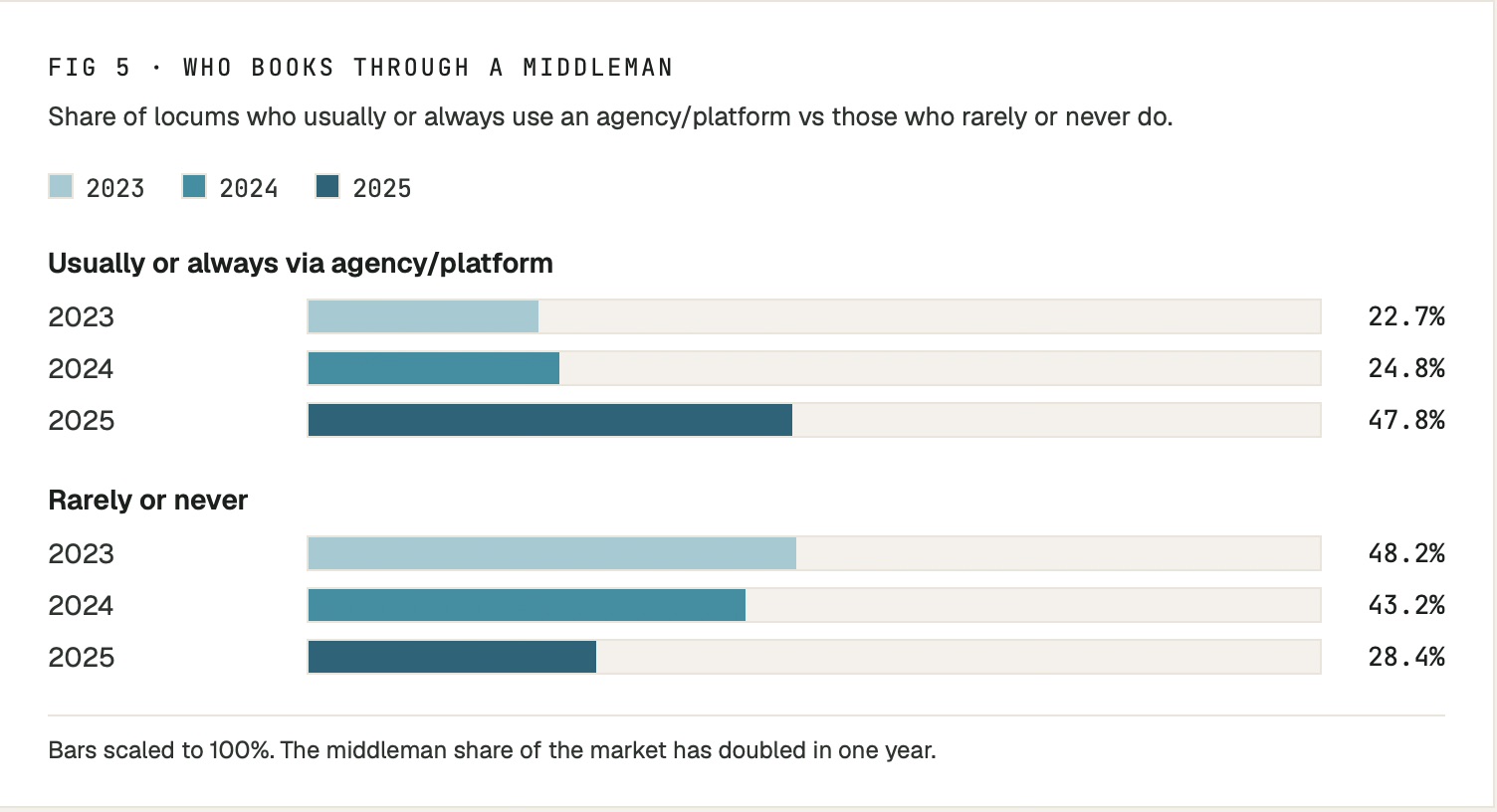
- Far more work now runs through platforms. 47.8% now usually or always use an agency or platform to find work, nearly double the 24.8% of 2024. Locate a Locum was again both the most-used platform and the worst-rated, for the third year in a row.
- People are retraining, and some are getting out. 24.2% of respondents are now independent prescribers, against 15.8% in 2023. Of those who are not, 53.4% are thinking about it. And 52.2% are taking, or seriously considering, courses to move into a different sector altogether.
The rest of this report goes through the findings in detail, looks at what they mean for individual pharmacists and for employed colleagues who never set foot in the locum market, and ends with what we think should change.
About the survey and who responded
A word on what the numbers can and cannot tell us. Every respondent gave a name, email, and GPhC number, so we are confident these are real registered pharmacists. Not everyone answered every question, so the percentages here are worked out from the number who answered each one, and we say so where it matters. And like any survey people opt into, it probably over-represents those who feel strongly one way or the other. The sample sizes also shrank over the three years (300, then 218, then 154), so the year-on-year lines are a guide to direction rather than a precise measurement.
One thing stands out about this year's group: it is the most experienced we have surveyed. 55.8% have been qualified ten years or more, up from 38.7% in 2023, and another 25.3% are five to nine years in. Only 4.5% qualified in the last year. These are not people on the edge of the profession working the odd shift. They are its experienced backbone.
For the first time, part-time locums are a slight majority, at 51.9% working under 30 hours a week. It would be easy to read that as lifestyle choice, but the written answers point elsewhere. Some full-time locums simply could not fill a week at a rate they would accept. Others had cut back on purpose, because they no longer wanted to depend on locum income.
Among the full-timers, 47.9% got 5 to 7 shifts a week and 49.3% got 3 to 4. The share scraping by on just 1 to 2 shifts fell from 9.4% last year to 2.8%, which looks like a real improvement, though some of it may simply be that the people who could not get work have already stopped looking. Most part-timers (72.6%) managed 1 to 2 shifts a week.
Rates: a third consecutive year of erosion
If there is one thread running through all three surveys, it is the steady fall in hourly rates. The most common rate band was £40 to £44 in 2023. By 2024 it had dropped to £30 to £34. This year that same £30 to £34 band held the top spot and grew, taking in 40.1% of respondents, while the share earning under £30 climbed again.
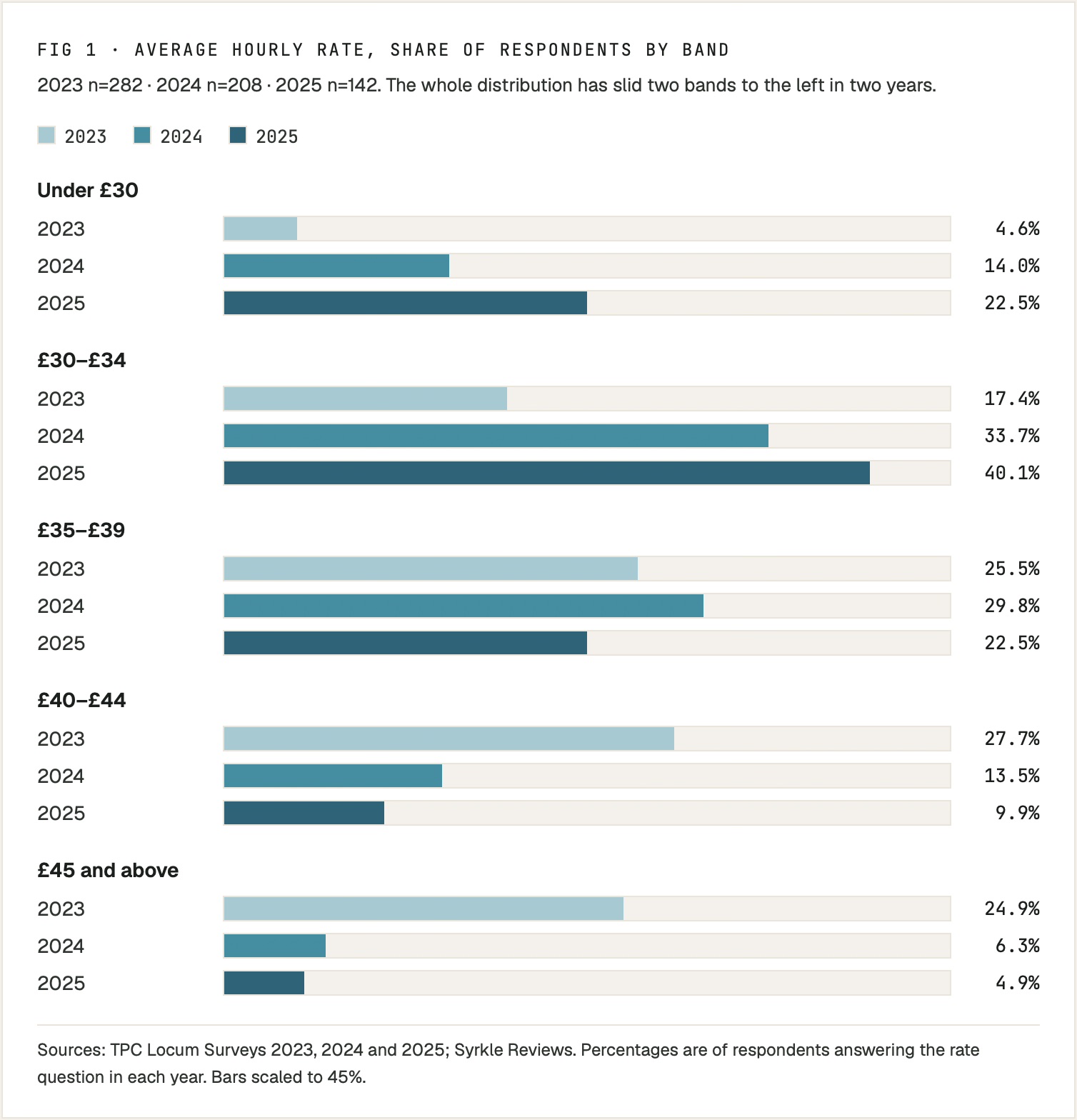
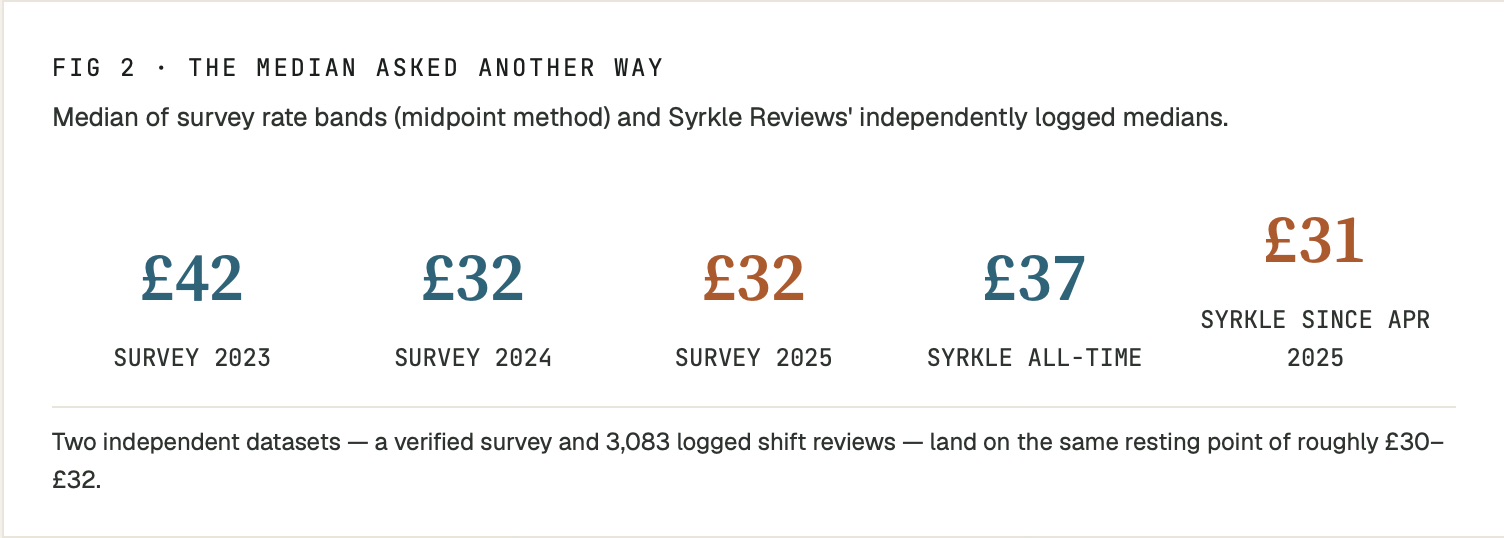
Put in pounds, a locum who could ask £42 an hour in 2023 and now takes £32 has lost roughly a quarter of their pay. That is before you factor in inflation, and it has happened while the job itself got harder, with Pharmacy First and a longer list of clinical services landing on whoever is behind the counter. Five respondents (3.5%) reported average rates of £21 to £24 an hour. As several of them pointed out, that can be less than an experienced dispenser or technician earns in the same building.
We do not have to take our own word for it. Syrkle Reviews, the platform UK pharmacists use to log what they were paid and rate where they worked, tells the same story. Across its full set of more than 3,000 reviews the median rate is £37, but narrow it to bookings made on or after 1 April 2025 and the median drops to £31. One reviewer in ten (10.6%) was paid £25 an hour or less, and the lowest rate anyone logged was £10. The geography matters too: Syrkle's median runs from £40 in Edinburgh down to £30 in London and Manchester and £28 in Birmingham. Where you happen to live is now a big part of whether locuming pays at all.
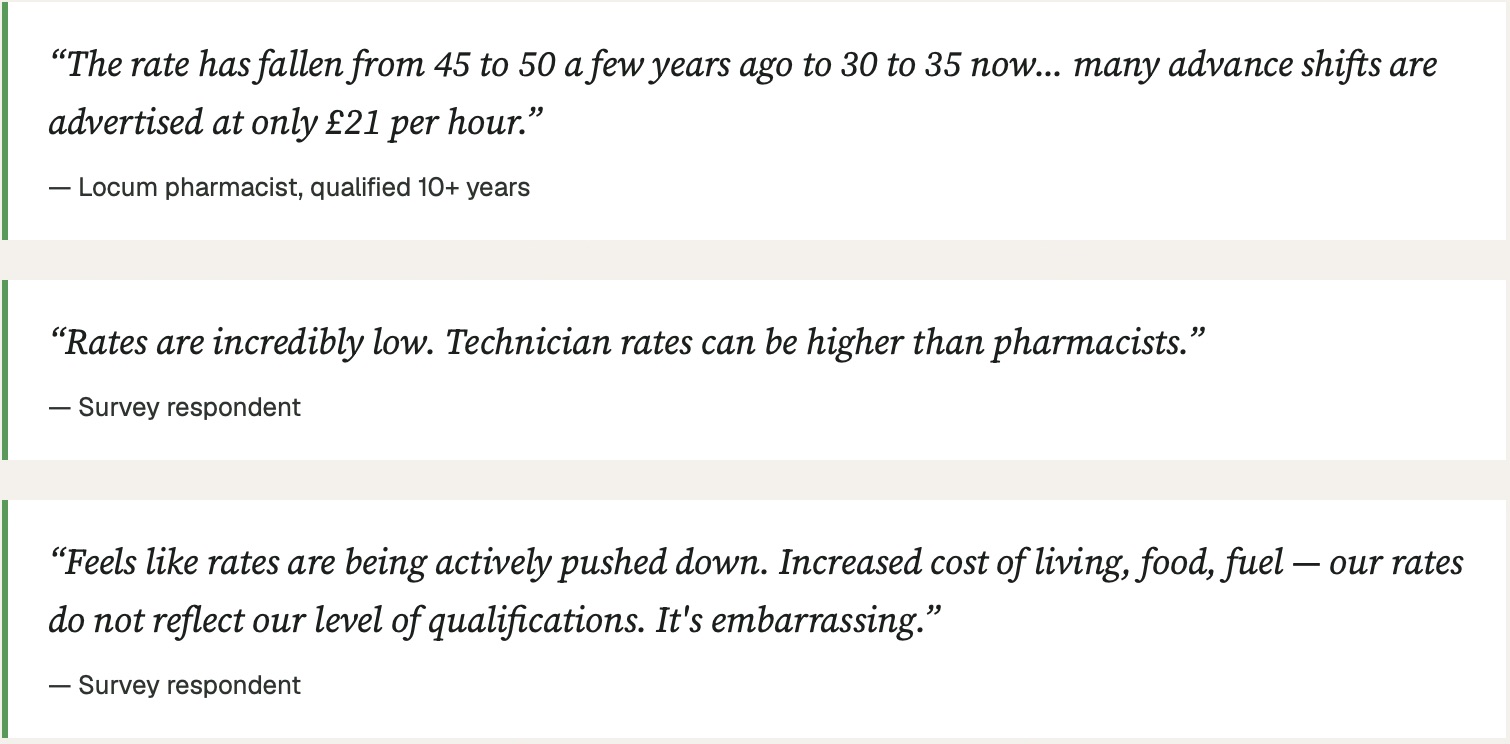
Respondents put the slide more plainly than any chart can:
Finding work: better than 2024, but far from healthy
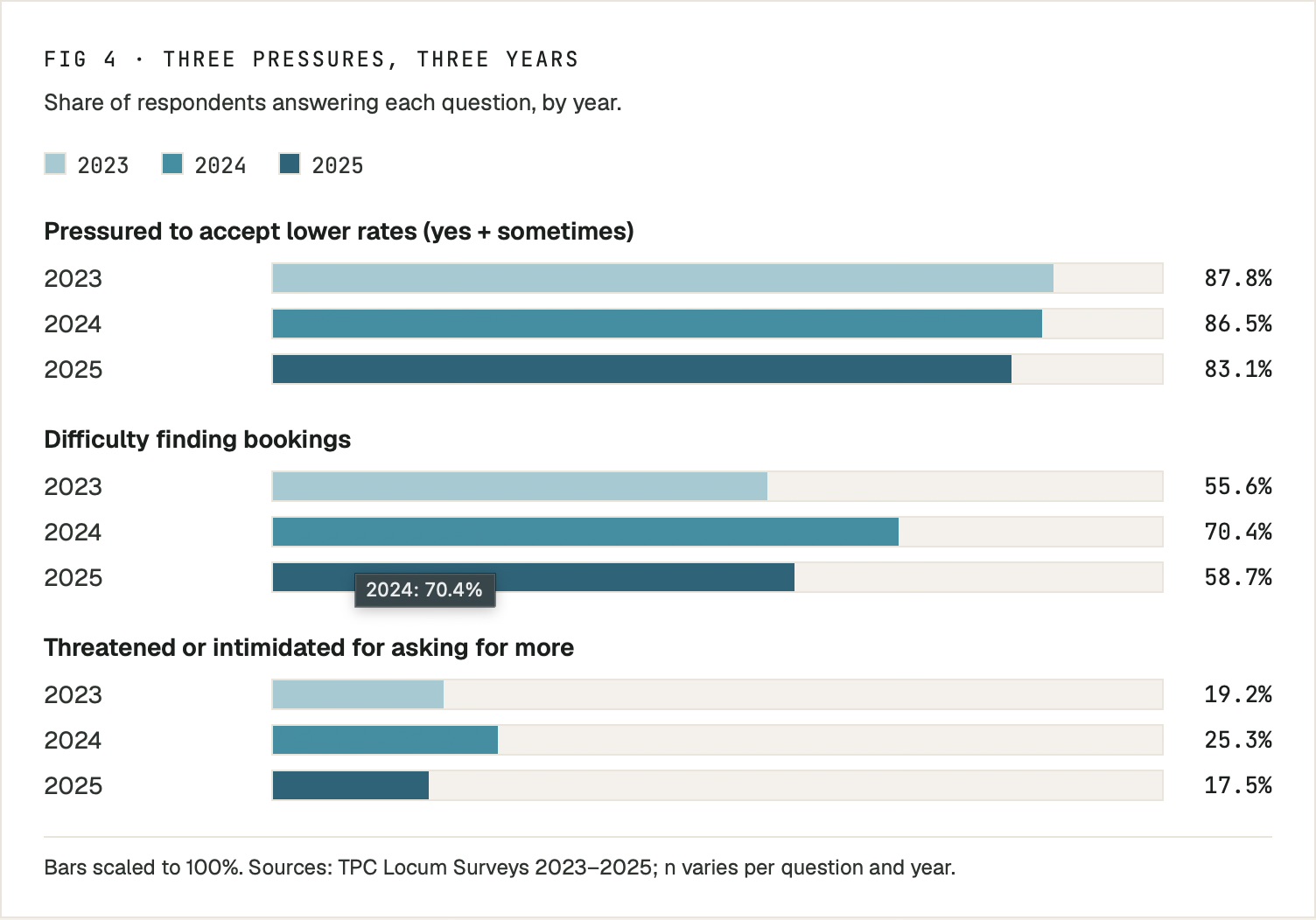
58.7% of respondents found it difficult to get bookings over the last year. That is a real step down from the 70.4% of 2024 and brings us back close to the 55.6% of 2023. Several people felt the market had stopped sliding. But as one of them noted, where it has stopped is not a comfortable place: “It's pretty easy already, the more pressing issue is finding well paid work.”
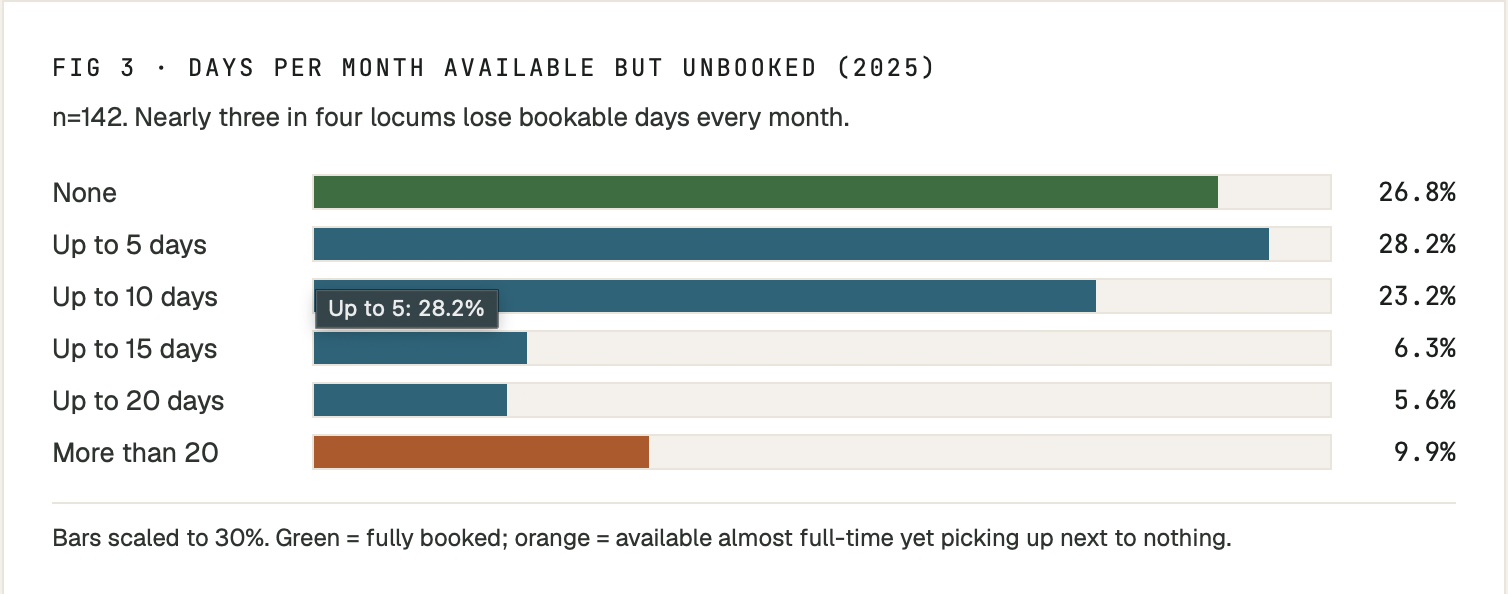
The bigger problem is empty days. We asked how many days a month people were free to work but could not get a booking. 73.2% had lost at least some. 21.8% lost more than ten days a month, and 9.9% lost more than twenty, which means being available almost full-time and picking up next to nothing.
Staying booked still means staying on the road. 71.1% of locums normally travel more than ten miles to a shift, 32.4% more than thirty, and 8.5% more than fifty. Several said their mileage payments had been stopped, so they are now covering that fuel themselves, which quietly eats into whatever the headline rate looks like.
When we asked what made finding work hard, the answers showed a market that has changed in shape, not just in price:
- Low rates with no room to haggle. This came up more than anything else. Shifts advertised at £21 to £25 gone before anyone could counter, and platforms that simply do not let you make an offer.
- Shifts held back, then turned into a contest. Work released at the last minute, or switched from “book now” to “apply now”, so locums end up bidding against each other for the same slot.
- Fewer shifts to go round. Pharmacies trimming their opening hours, especially at weekends, and divested branches passing to independents who never advertise openly.
- Speed as the gatekeeper. As one put it: “Shifts going within minutes of being posted in WhatsApp groups. If you don't check every alert, even while working, you miss out.”
- Paperwork that locks you out. Compliance documents uploaded over and over, DBS checks stuck in re-verification, and onboarding hoops that keep you off the rota while you wait.
Pressure on rates and the negotiation gap
55.8% of those answering said they had been pushed in the last year to take rates lower than they were comfortable with, and another 27.3% said it happened sometimes. Together that is 83.1%. It is the third year running the combined figure has sat above 80% (87.8% in 2023, 86.5% in 2024). The pressure has eased a little, but from a very high starting point.
What has really changed is how the pressure arrives. In 2023 people mostly described being haggled down in person. This year they describe something more built-in: platforms with no negotiation button, multiples that will only book you through one app, advertised rates that are treated as final, and rates that get quietly cut after you have already accepted. On top of the headline figure, several lost their paid lunch break or their mileage, neither of which shows up in the rate you see advertised. One locum was offered ordinary weekday rates for bank holiday work and told it was non-negotiable.
The big multiples came up by name again and again, Boots most of all, with Tesco, Asda, and Well close behind, setting fixed rates of £20 to £28 an hour and refusing to move. One pharmacist described a contractor who had worked out the lowest rates locums were accepting nearby and used it to chip down an emergency-cover offer: “I know the local rates here now. I can pay you £26.”
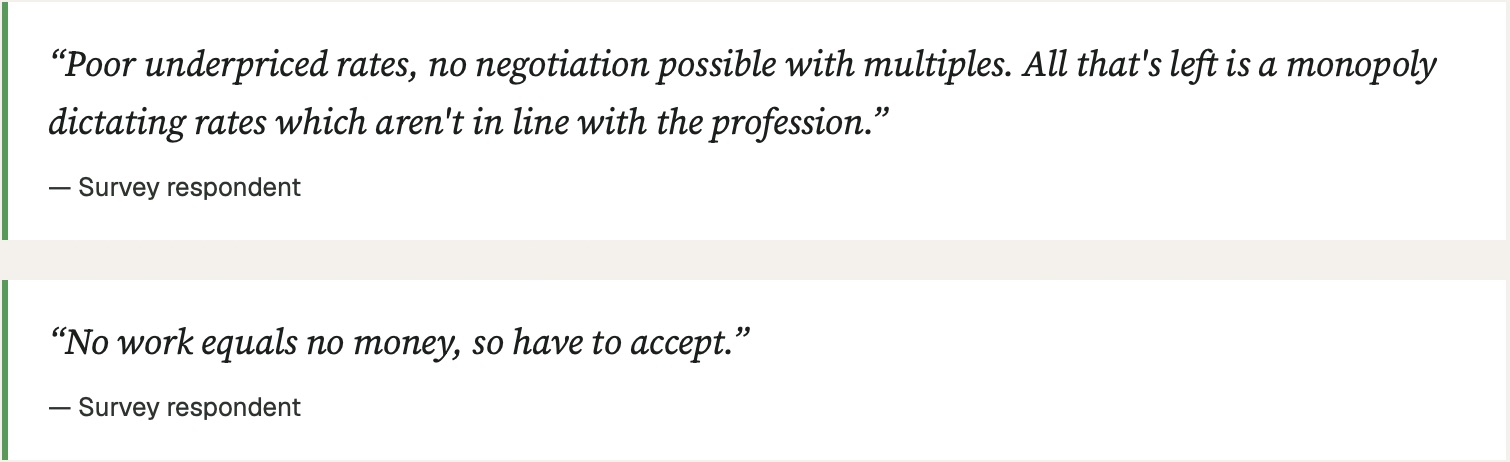
Then there is the part that clearly stings the most: locums undercutting each other. Hold out for a fair rate and you watch the shift go to a colleague who will take less. Several people pointed to this loss of solidarity as the thing that lets everything else happen. One full-time locum summed up the trap:

Intimidation, blacklisting, and the cost of asking
17.5% of respondents, about one in six, had been threatened or intimidated for asking for a higher rate. That is down from 25.3% in 2024 and 19.2% in 2023, which is worth saying clearly. Most pharmacists have never had this happen, and plenty wrote warmly about agencies and pharmacies they deal with.
Still, the cases that were reported rhyme with one another, and the punishment is rarely a raised voice. It is usually something quieter and administrative:
- Being barred or blacklisted. Accounts suspended after a negotiation, names dropped from booking platforms and mailing lists, and the unspoken understanding that asking too often gets you quietly frozen out.
- Future bookings pulled. More than one respondent had all their upcoming shifts cancelled after they asked for more.
- Squeezed mid-shift. One locum was asked partway through the day to move to another branch, asked to be paid for both, was refused, and was then banned by the multiple altogether.
- Made to feel small. “They ensure you're made to feel unworthy of such a rate,” one wrote. Another described an independent owner turning “very aggressive” when they linked a rate request to the recent funding uplift.
- Reported to the regulator. One respondent says a pharmacy reported them to the GPhC after they asked for a higher rate. We are keeping the details confidential. Whatever lies behind that particular case, using a regulatory referral as a bargaining chip over money would be a serious misuse of the process.
The trouble with negotiating through a platform is that the cost of asking is logged, permanent, and out of sight. A locum who gets quietly pushed down an algorithm's list, or dropped from a database, gets no hearing and no right of appeal. That is exactly what several respondents asked us to push for: protection from being punished for negotiating, and some transparency about how these platform decisions actually get made.
Agencies and platforms: doing more of the booking, earning little of the trust
The clearest structural change this year is how much work now passes through a middleman. In 2023, 48.2% of locums rarely or never used an agency. In 2024 it was 43.2%. This year only 28.4% rarely or never use one, while those who usually or always rely on agencies and platforms have jumped from 22.7% in 2023 and 24.8% in 2024 to 47.8%. And respondents are blunt that a lot of this is not a choice: some multiples will not take a direct booking at all any more.

We asked people to rate 24 named agencies and platforms. The scores bunch around the middle of the five-point scale, and even the best of them only manage a passable mark:
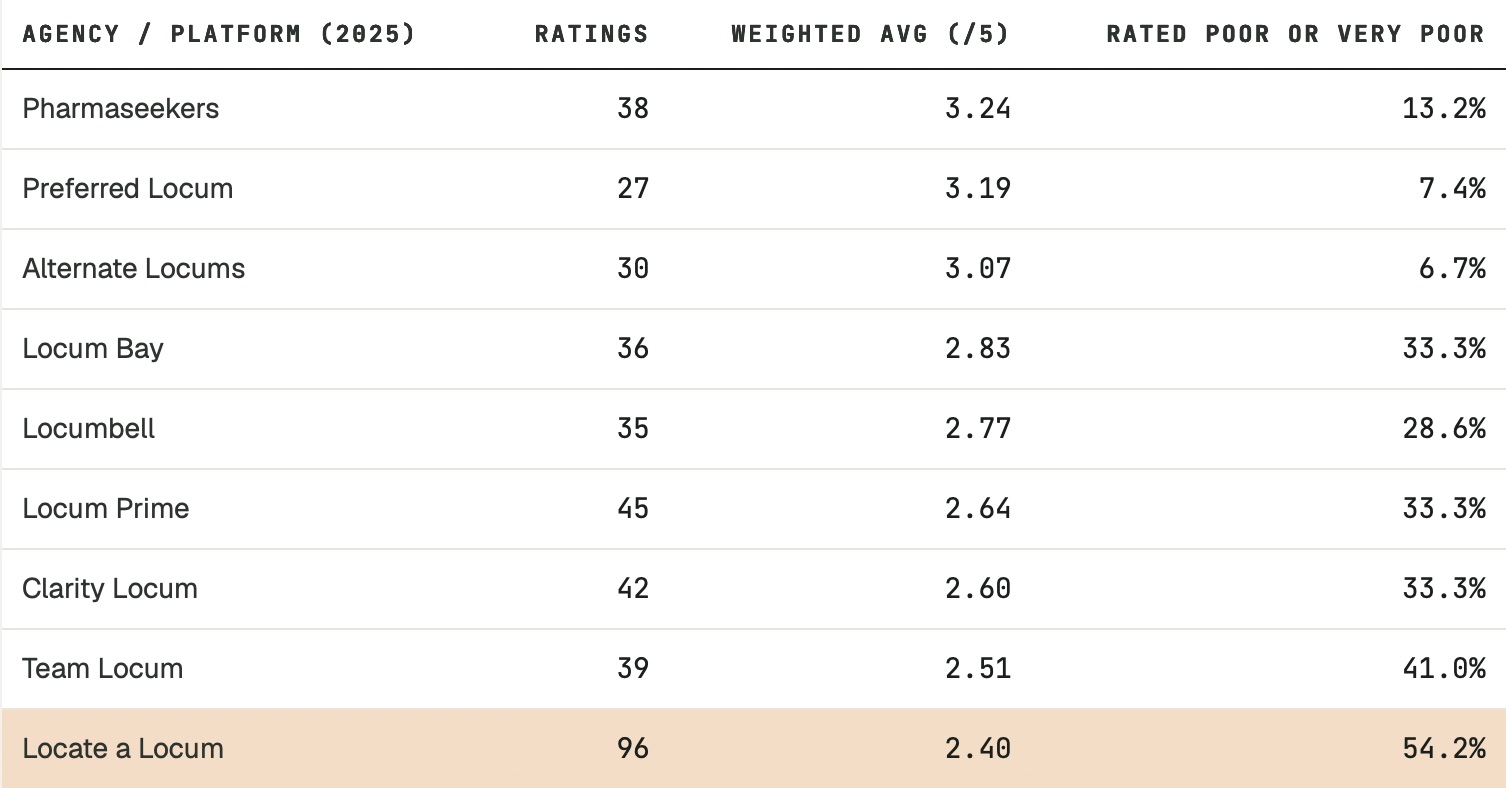
Locate a Locum is once more both the most-used platform, with 96 people rating it, nearly three times any rival, and the worst-rated. It has held that double distinction in all three surveys (a weighted 1.77 in 2023; 76.9% rated it poor or very poor in 2024). The complaints barely change from year to year: no real negotiation, low fixed rates dressed up as market rates, counter-offers that go slow or unanswered, and accounts barred after someone asks for more. One respondent went further, claiming, and saying they hold emails to prove it, that the platform strips out higher-than-usual rates as outliers before it calculates the “market rate” it then quotes back. We have not verified that, but it is the kind of claim the platform ought to answer in the open.
To be fair, it is not all one way. Several people had warm words for individual agencies, with Pharmaseekers singled out as “always very professional”, and some were careful to blame the contractor setting the rate rather than the agency listing the shift. The real problem they describe is not one bad firm. It is a market built so that the middleman's interests line up with whoever is paying, not with the pharmacist doing the work.
The human cost
Every percentage in this report is a person making choices that were not on the table three years ago. What strikes you reading the written answers is not anger so much as tiredness. And it is clear the rate is no longer an abstract market question. For some people it now decides whether they stay a pharmacist at all.
One respondent has already gone:

For parents the sums have turned brutal. One locum described weighing up a last-minute shift against wraparound childcare at £21 a child: take it and maybe clear barely more than the childcare cost, or turn it down and earn nothing. For pharmacists with a health condition or disability it is harder again. One respondent with mobility problems takes £23 to £25 an hour just to stay in pharmacies they know, because, in their words, they do not have “the mental energy to haggle”. They were told by an employer that they were a great pharmacist but were “holding back pharmacy” because they were physically too slow. Another asked for £30 an hour during Ramadan and was turned down at £28.
Safety runs through these answers too. One locum had turned down shifts where they would have been the only qualified person in the building with no trained support, work that someone under more financial pressure presumably ended up covering. Another asked for nothing more than “not being left alone in the pharmacy” and “not being blacklisted for challenging poor practices”. That is the part that should worry everyone: when the pay no longer makes up for the risk, the only people who can afford to say no to an unsafe shift are the ones who do not need the money. The safeguard works backwards.
And under all of it is something people kept circling back to, harder to put in a statistic: the slow chipping-away at how they value themselves. Pharmacists with ten or fifteen years behind them, a prescribing qualification, and a longer job than ever, telling us they feel embarrassed by a rate that reflects none of it.
Knock-on effects: why employed pharmacists should care
It is easy to file this under “locum problem” and move on. That would be a mistake. The locum rate is really the going price of a pharmacist's day, the number an employer holds up against the cost of a salaried pharmacist when it is setting budgets, filling a gap, or deciding how hard to fight to keep someone. When that number drops by a quarter in two years, every employed pharmacist's hand gets weaker too. Salary offers, overtime, the appetite to improve conditions: all of it is tied, one way or another, to what cover costs.
It runs the other way as well. Once locuming stops paying a premium, the locum pool fills up with people who would honestly rather have a permanent job, and employed pharmacists lose the one credible threat they had, which was to walk and locum instead. A respondent in Scotland laid out the mechanics:

So it loops. Poor conditions in employed jobs push people into locuming. The bigger locum pool drags rates down. The lower rates then close off the escape route that used to keep employers honest about conditions in the first place. Each half of the workforce ends up stuck because of the other half's problem.
Caught in the middle is a growing group of long-term “resident” locums, working the same pharmacy for months or years on end. They carry an employee's responsibilities without an employee's protections: no sick pay, no holiday, no redundancy, and now not even a rate premium to make up for it. One respondent asked us straight for “better rights and working conditions, especially for long term locums who are in effect resident”.
And the job has got bigger while the pay shrank. Pharmacy First and the wider clinical services have raised the bar for whoever is on duty, locum or not, and respondents are adamant the money attached to those services is not reaching the people actually delivering them. A number also pointed to the rising tide of pharmacy graduates and the new schools of pharmacy as the root of oversupply. That kind of workforce planning sits with the Department of Health and Social Care and NHS England, not the regulator, which has to register everyone who meets its standards and cannot cap numbers even if it wanted to. Read charitably, the frustration is really a plea for something that does not yet exist: a credible national picture of how many pharmacists the country needs, where, and to do what.
What nine years of private conversation says
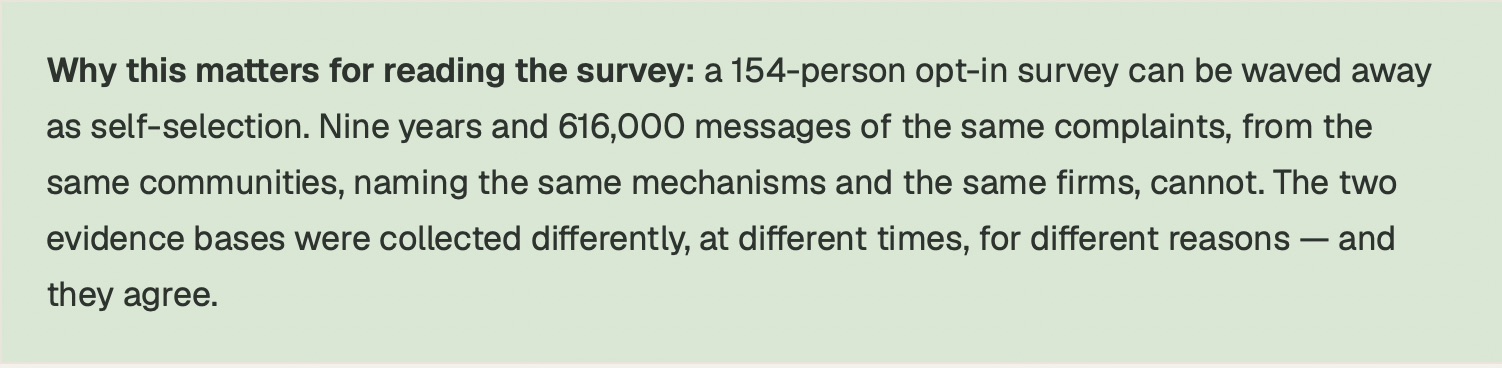
New this year: alongside the survey, we analysed the message history of the TPC Telegram network — more than 616,000 messages across 20+ pharmacist groups, from 2017 to 2026, processed with NLP (sentiment, topic and intent per message; content redacted at source; no patient or member names; every connection in the resulting knowledge graph carries an audit tag). It is the closest thing the profession has to a longitudinal record of what pharmacists say to each other when nobody official is listening. Three things stand out.
- The survey findings are not new grievances — they are old ones, on the record for years.The undercutting mechanism described in Section 4 (book a locum, re-advertise the shift cheaper, cancel the original) appears in members' warnings to each other from 2018 onwards. Chronic late- and non-payment complaints about the same named employers recur across 2018–2025. The Locate a Locum criticisms in Section 6 — fixed rates, no negotiation, quiet barring — track a boycott movement visible in the network from 2023.
- Sentiment corroborates the numbers. In messages mentioning locum work, complaints and warnings outnumber praise by roughly 16 to 1 (12,411 vs 781). Brand-level sentiment is negative for the large multiples (Boots −0.13, Lloyds −0.14 on a −1 to +1 scale) and neutral-to-positive only for independents.
- The most-discussed entity in nine years of pharmacist conversation is the regulator. In the network's knowledge graph, the GPhC is the single most-connected node — ahead of any employer, platform or scheme. A workforce this experienced does not talk about its regulator that much because things are going well.
Adapting: prescribing qualifications and exit routes
Stuck in a flat market, people are doing the sensible thing and retraining. 24.2% of respondents are now independent prescribers, up from 15.8% in 2023, and 53.4% of those who are not yet qualified are weighing it up. The places they hope to use it cluster around community services like Pharmacy First Plus, general practice and primary care, and private clinical work, with weight-loss services, dermatology, aesthetics, sexual health, mental health, and substance misuse all named.
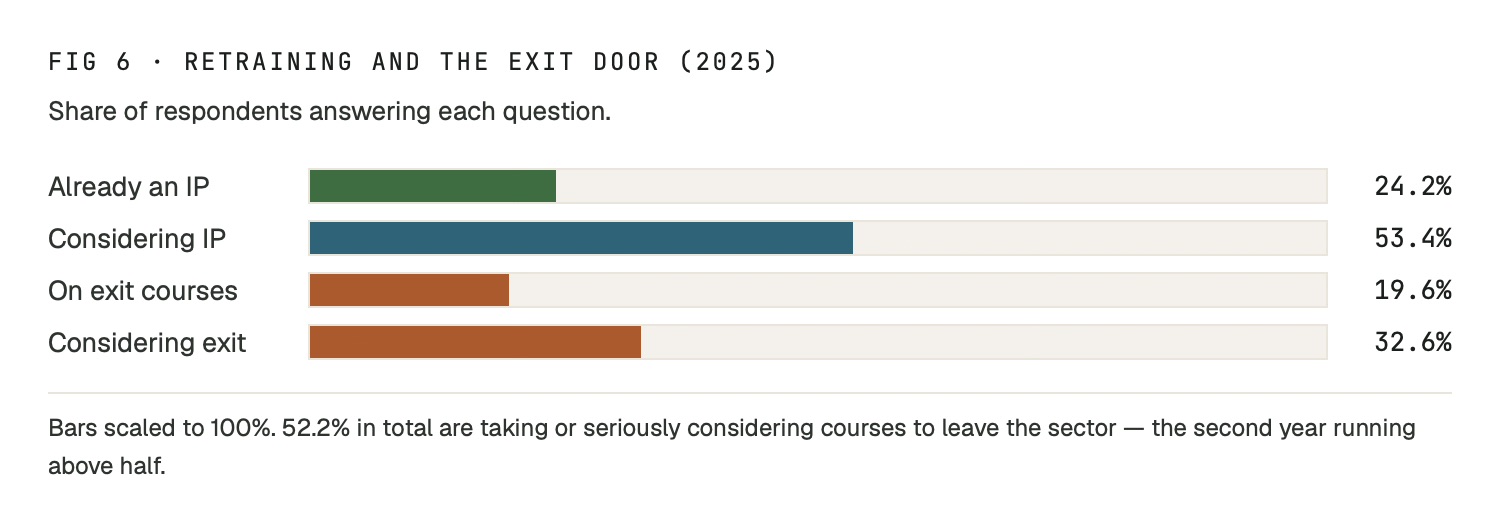
You can read this two ways, and honestly both show up in the answers. The hopeful version is that pharmacy's clinical role is growing and locums are getting ready for it. One respondent reckoned the market was “becoming more stable” and that, with every new graduate now qualifying as a prescriber, locums simply have to “either train to become prescribers or try different fields”. The bleaker version is that the qualification has become a hedge, “I think I will need it for bookings in the future”, and for plenty of people it is an exit visa. 19.6% are already on courses to move into a different sector and another 32.6% are seriously thinking about it: 52.2% in total, much the same as last year's 54.2%. This is not just upskilling. For the second year running, more than half of our most experienced flexible workforce has a foot out of the door.
What locums want
88 people answered when we asked what would make finding work easier, and they wanted strikingly similar things. Roughly in order of how often they came up:
- A floor under rates. The most common ask by far. Most suggestions sat at £30 to £35 an hour, tied to inflation, and several wanted locums to agree a floor among themselves rather than wait for one to be handed down.
- The right to negotiate everywhere. A negotiation button on every platform, an end to fixed take-it-or-leave-it rates, and no punishment for asking.
- Direct booking. Being able to deal with the pharmacy itself again, instead of being funnelled through one app.
- Honesty about the numbers. What the agency takes, what the shift actually involves before you accept, and how a platform works out the “market rate” it quotes.
- Consequences for closing. Some comeback for pharmacies that shut for the day rather than pay a fair rate while locums sit available.
- Sticking together. Stop the undercutting, organise, and, as several said outright, back a single body that speaks for locums.
- Funding that reaches the counter. If services and their funding have grown, that should show up in the pay of the pharmacist delivering them.
Conclusions and recommendations
This year's survey shows a market that has stopped falling and started to settle, but at a level the profession really should not treat as normal. The good news is genuine and we will not bury it: fewer locums struggled to find work than in 2024, fewer were intimidated, and full-time locums got more shifts. The catch is that the calm was bought with pay. The share earning under £30 an hour has quintupled in two years, the £45-plus that a quarter of locums earned in 2023 has all but disappeared, and both our survey and Syrkle's independent figures land on the same resting point of about £30 to £31 an hour. This is happening to a workforce that is older, better qualified, and doing more clinical work than ever.
Here is what we think should change.
- DHSC and NHS England should publish a national workforce demand model across all sectors, so training places, registration numbers, and service commissioning are planned on evidence rather than worked out after the fact through collapsing rates. And the funding for expanded services should be shown to reach the pharmacists doing the work.
- Booking platforms and agencies should put a negotiation option on every shift as standard, publish how their advertised and “market” rates are calculated including what they do with outliers, and give locums a clear, appealable process before anyone is barred, suspended, or quietly pushed down the list.
- Contractors and multiples should advertise the full terms of a shift, the rate, breaks, mileage, the services expected, and what staff support there will be, before it is booked. Pay the break when the pharmacy trades through it. And treat a rate request as a normal conversation, not a reason to drop someone from the database.
- Locums can help themselves too. Check the going rate before you accept and log your own through Syrkle Reviews, so the transparency cuts both ways. Tell us about intimidation or retaliation; we keep it confidential. And hold your floor where you can afford to, because undercutting only hands the advantage straight back.
As for us, we will keep running this survey every year, keep publishing it in full, keep putting what is in here to platforms, contractors, and policy-makers, and keep building the things locums have told us they want: rate transparency, representation, and a community with some weight behind it.
Last thing. To everyone who took the time to fill this in, often at real length and with real candour: thank you. There is no report without you, and we know that putting your own pay and treatment on the record is not a small thing to do.
Methodology and citation note. The TPC Locum Survey 2025 was conducted online between February and May 2026, asking about the preceding 12 months. 154 respondents were verified by name, email, and GPhC registration number; percentages are based on respondents answering each question. Comparison figures are drawn from the TPC Locum Survey 2023 (300 respondents) and 2024 (218 respondents), available at pharmacistcoop.co.uk. Independent rate data is drawn from Syrkle Reviews, the community rate-transparency platform used by UK pharmacists (3,083 approved reviews; 2025/26 figures based on 199 reviews of bookings on or after 1 April 2025). Telegram network analysis (Section 9): 616,791 NLP-analysed messages, 2017–2026, 20+ TPC community groups; messages redacted at source; sentiment scored −1 to +1; figures are drawn from the TPC/SMAT analytics database and knowledge graph, and describe member-reported experiences. Any quotation of rate changes from this report should cite the TPC Locum Survey (2023–2025) and Syrkle Reviews.
© 2026 The Pharmacist Cooperative · pharmacistcoop.co.uk
https://pharmacistcoop.co.uk/articles/tpc_locum_survey_2024/
https://pharmacistcoop.co.uk/articles/tpc_locum_survey_2023/